

CoreWeave and the AI Compute Race: Why Big Tech Outsources GPUs
Even hyperscalers are renting AI capacity instead of building it. Here’s why that matters.

Commodity, Competitor, or Client?
The AI world is moving at a pace few industries have ever seen. Every company - from startups to trillion-dollar giants - is racing not just to build the next product, but to discover the next problem AI can solve. Yet behind every breakthrough model and every headline-grabbing demo lies the same bottleneck: compute capacity.
All AI runs on the same thing: hardware, networking, electricity, and infrastructure. That’s where CoreWeave CRWV 0.00%↑ comes in. It doesn’t make chips, design algorithms, or sell consumer software. Instead, it provides the compute backbone that makes AI possible. And lately, even the most prominent players in tech are depending on it.
A Commodity Or Something More?
At first glance, CoreWeave looks like a commodity business. It buys Nvidia GPUs, racks them, powers them, and rents them out. Straightforward enough. But that view misses the technology behind it.
Most hyperscalers like Amazon AMZN 0.00%↑, Google GOOGL 0.00%↑GOOG 0.00%↑ , and Microsoft MSFT 0.00%↑ built their cloud empires to handle traditional workloads: file storage, databases, and enterprise applications, among others. These tasks are predictable and steady, running for weeks or months with relatively consistent demand.
AI doesn’t work that way. Training a large model can require hundreds or even thousands of GPUs for a few hours or days, followed by long stretches of lower-intensity inference work. The load spikes and collapses with the need. Traditional data centers, optimized for steady-state compute, aren’t designed for this volatility.
CoreWeave’s infrastructure was built from the ground up for AI’s rhythm. Moreover, it’s designed to give users more direct access to the raw hardware - stripping away the extra virtualization layers slowing things down - while still allowing workloads to scale fluidly between massive training runs and lighter inference tasks.
The difference may sound small, but for AI performance and efficiency, it’s massive. It’s what turns a rack of GPUs into a finely tuned, revenue-generating engine.
Why Hyperscalers Are Buying Instead of Building
If the big cloud players already have enormous data centers, why are they contracting with CoreWeave at all?
The answer comes down to time and specialization.
Data centers built for AI acceleration are not the same as those built for general computing. They require denser networking, optimized cooling, and precise synchronization across thousands of GPUs acting as a single unit. Building that from scratch - even for companies with unlimited resources - takes years.
And AI moves faster than construction.
So while hyperscalers and major AI labs expand their in-house infrastructure, they’re renting from CoreWeave to fill the gap. It’s a practical decision: pay for what you need now, and keep your teams’ training models instead of waiting for new data halls to open.
When Competitors Become Clients
What’s fascinating about CoreWeave’s position is that it has turned potential competitors into customers. Meta Platforms META 0.00%↑, OpenAI, and even Nvidia NVDA 0.00%↑ have signed multi-billion-dollar contracts for CoreWeave’s compute capacity.
That dynamic says a lot about the current AI landscape. The bottleneck isn’t talent, software, or even ideas - it’s infrastructure. Whoever controls reliable, high-performance compute controls the pace of progress.
And while hyperscalers will eventually bring more capacity online, the economics of owning versus renting remain compelling. Building AI data centers costs tens of billions upfront and locks companies into a constant upgrade cycle as new GPU generations roll out. Renting converts those costs into operating expenses and provides flexibility in a market that changes every quarter.
It’s a rare situation where agility beats scale - at least for now.
The Nvidia Factor
CoreWeave’s close partnership with Nvidia gives it another quiet edge. Because Nvidia both supplies and invests in the company, CoreWeave often gets early access to the latest GPU generations before most of the market. Nvidia benefits too, ensuring its chips are deployed efficiently while offloading the cost of hosting them.
That relationship gives CoreWeave a running start in every new hardware cycle - a small but meaningful advantage in a world where faster compute directly translates to faster innovation.
The Bigger Picture
CoreWeave’s rise is part of a larger shift underway in computing: the transition from general-purpose cloud infrastructure to purpose-built AI capacity. Even as hyperscalers expand their own AI data centers, demand for flexible, GPU-optimized compute continues to surge.
Whether CoreWeave remains a stopgap for hyperscalers or becomes a long-term pillar of the AI ecosystem will depend on how it balances growth, cost, and differentiation. But one thing is already clear: AI has turned compute into one of the most valuable commodities on the planet, and CoreWeave has found itself in the middle of that gold rush.
In an industry obsessed with algorithms, sometimes the real power lies in the hardware - and the company that can deliver it when no one else can.
Quick Chart Look
As for its chart, since CoreWeave doesn’t have a long track record and has a lot of gaps and volatility on the chart, I have to wait for more clarity. If it can get through the $154 resistance area - or hit it and hold the $132 level on a pullback - then we’re looking at the beginning of a new rally in the stock. If it hits the $154 area and drops and begins a five-wave decline, it’s likely the stock is headed to the $67 area to complete a larger corrective and consolidation move from the large spring rally.
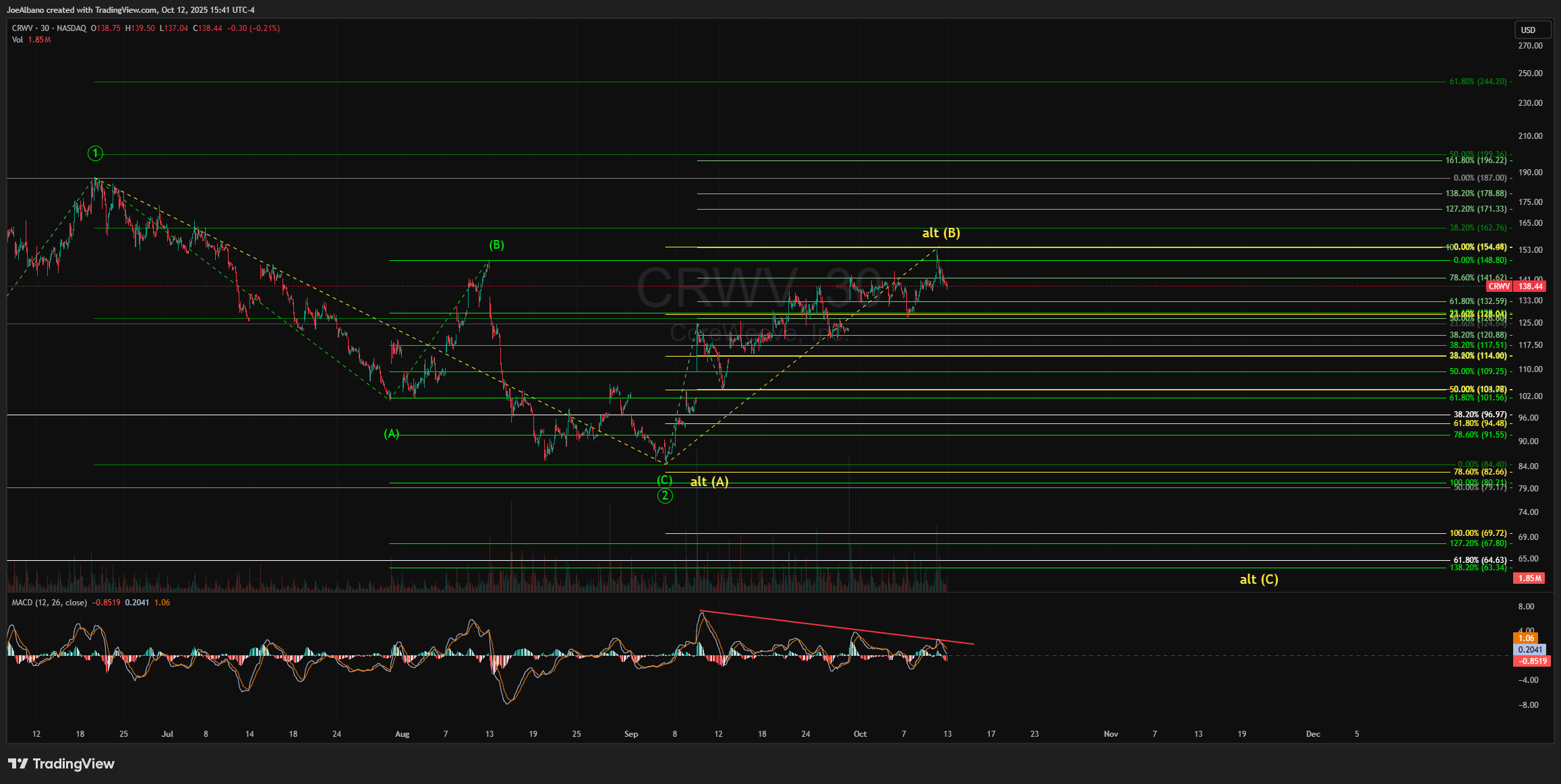
Either way, more confirmation is needed to know when the time to go long is.